AI Automation Services
Three focused engagements. Each starts with a free 30-minute discovery call and a written diagnostic — no pitch decks, no vague timelines.
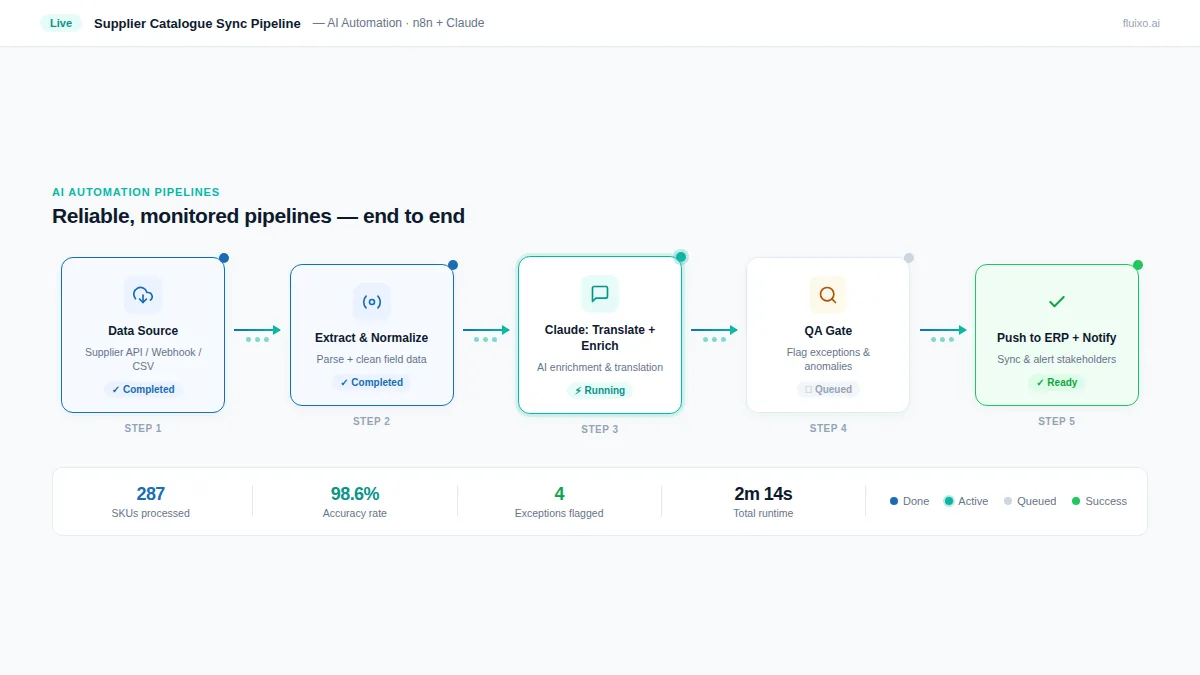
Automate the Work
AI Automation Pipelines
Replace a manual, error-prone process with a reliable, monitored AI pipeline.
Your team spends hours on tasks that follow a pattern — data entry, file processing, catalogue updates, content production, reporting. The work repeats. It shouldn't.
Deliverables
- — Process architecture document
- — Data flow and integration spec
- — Production pipeline (tested, monitored, with alerting)
- — Human review gates for flagged exceptions
- — Handover documentation and operator guide
Real Examples
- — Supplier catalogue ingestion for a European textile distributor — 300+ updates/day, auto-translated and enriched, pushed to ERP with exception flagging
- — Aviation training content pipeline — regulatory PDFs → structured lesson drafts → instructor approval → ready-to-publish materials
- — Lead enrichment pipeline — CRM records → AI scoring and research → enriched profiles for sales
4–8 weeks fixed scope. Clear go/no-go after week 2.
Phase 1 — Week 1–2
Process audit, data mapping, integration design
Phase 2 — Week 3–6
Build, test, iterate with real data
Phase 3 — Week 7–8
Production handover, documentation, go-live
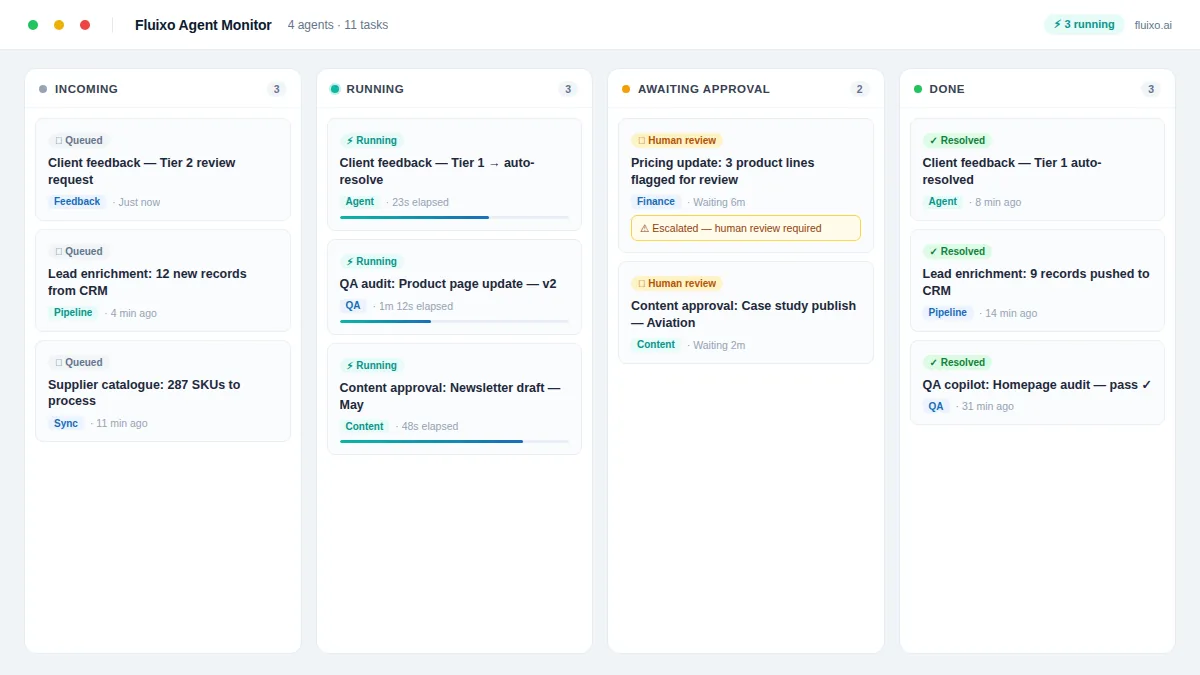
Build Agents That Own Tasks
Production Agent Systems
Custom AI agents that operate end-to-end with safety gates and human approval at the right moments.
You need more than a pipeline. You need an agent that makes decisions, handles exceptions, escalates when needed, and keeps running — reliably, in production.
Deliverables
- — Agent specification and behavior document
- — Safety gates and human approval flow design
- — Production system (deployed, tested, with rollback)
- — Observability and monitoring setup
- — Operator runbook
Real Examples
- — Client feedback handling system that classifies, routes, and resolves tier-1 issues — escalates tier-2 with full context
- — QA copilot that audits content and data changes before they go live, with defined pass/fail criteria and rejection flows
- — Autonomous content steward that monitors, updates, and publishes based on business rules — with human editorial gates
6–12 weeks. Phased rollout — pilot before full production.
Phase 1 — Week 1–2
Agent spec, safety map, integration design
Phase 2 — Week 3–8
Core build, safety gates, testing
Phase 3 — Week 9–12
Phased rollout, monitoring, production hardening
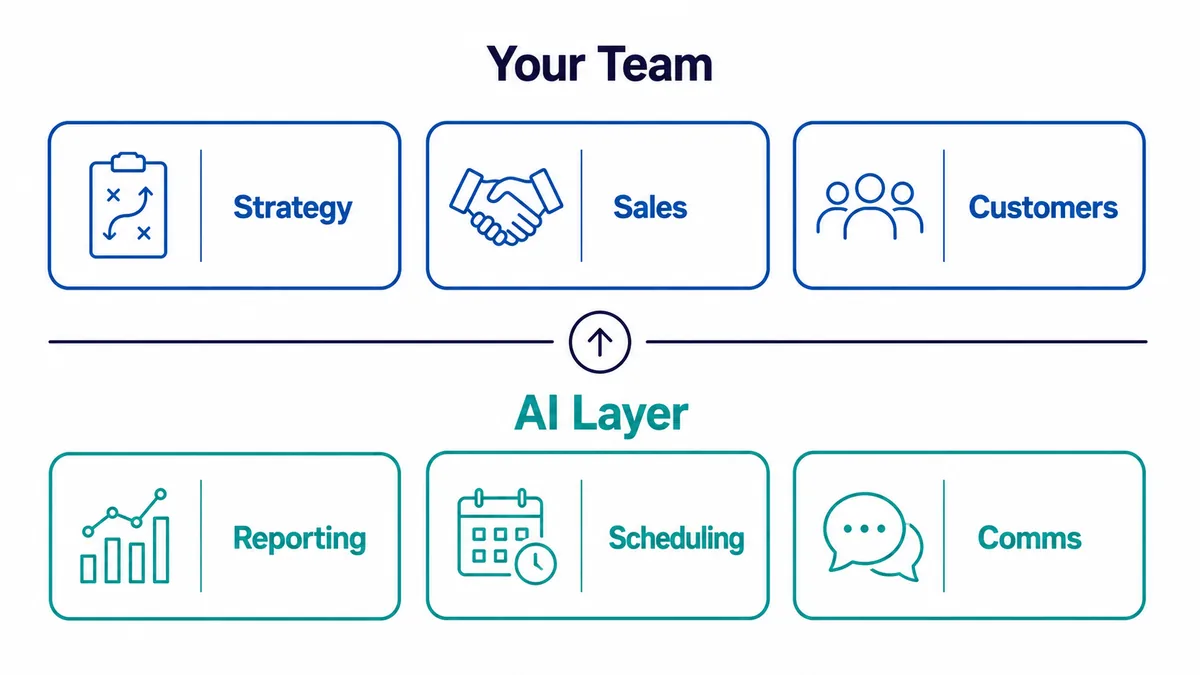
Install the Operating Model
AI-Led Operations
An operating model where AI owns the routine work — routing, escalation, QA, reporting — while your team focuses on high-value decisions.
You've automated one process. Now you want AI running the full ops layer — ticketing, routing, daily briefings, cross-function reporting — so you can scale without proportional headcount.
Deliverables
- — Operating model document (what AI handles, what humans own)
- — Ticketing and routing setup
- — Escalation matrix and human gates
- — Daily/weekly founder brief template
- — KPI dashboard (read-only reporting)
Real Examples
- — Cross-project ticketing system — AI classifies, routes, and follows up; humans approve escalations
- — Daily founder brief — AI aggregates status, flags blockers, and surfaces decisions that need human input
- — Multi-project QA discipline — AI runs pre-flight checks on every release; humans gate production deploys
Ongoing retainer. Starts with a 4-week setup sprint.
Week 1–2
Operating model design and tool setup
Week 3–4
Pilot with your team, calibrate gates and routing
Ongoing
System runs, weekly review, continuous expansion
How Every Engagement Works
- 01
Free discovery call
30 minutes. We map your highest-leverage ops and identify where AI adds real value.
- 02
Written diagnostic
A document: current process, automation scope, success definition. No decks.
- 03
Scoped proposal
Timeline, deliverables, and price. No vague retainers. No hidden scope.
- 04
Build
Phased delivery with defined check-ins. Real-data testing before production.
- 05
Handover
Full documentation, operator guide, and optional ongoing maintenance.
Common questions
Do you replace existing tools like Zapier or Make? +
Not necessarily. We build on top of your existing stack where it makes sense — or replace it when a custom system is more reliable. The decision is in the diagnostic, not the pitch.
What if we don't know what to automate? +
That's exactly what the discovery call is for. Most clients come with a problem, not a solution. We identify which processes are worth automating and in what order.
How do we know agents won't make mistakes? +
Every system we build includes human review gates for decisions that matter. Agents handle what's routine; humans approve what's consequential.
What's included in the fixed scope? +
A production-ready system — built, tested, deployed, documented, and handed over. Not a prototype.
Can you work with our existing team or developers? +
Yes. We integrate with your existing stack and technical team. We deliver the system; your team owns it after handover.
Not sure which fits?
The discovery call is the diagnostic. 30 minutes. No pitch.